SONGBIRD: Strengthening Emergency Response
Improving drones to assist first responders in disaster situations.

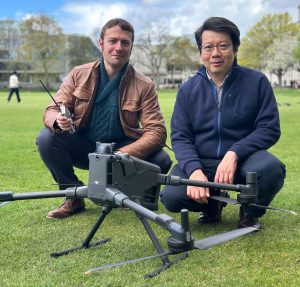
Dr Boris Galkin of Tyndall National Institute and the CONNECT Research Ireland Centre for Future Networks and Communications has been awarded a Royal Society–Research Ireland University Research Fellowship to lead SONGBIRD (Sensing Operations in Networks of Ground-and-Air Devices), a project developing AI-powered sensing technology for drones using radio signals.
The project harnesses radio signal reflections to help drones understand and map their surroundings without relying on expensive cameras or sensors. By analysing how radio signals travel, reflect from objects and interact with obstacles such as trees and buildings, drones can build detailed environmental maps and identify objects of interest, even in challenging conditions.
Building on previous drone research projects, including MISTRAL and GUARD, the technology has the potential to support search and rescue operations, air traffic management and urban planning. Unlike conventional cameras, radio-based sensing can operate effectively in low-light conditions and where visual line of sight is obstructed, offering new opportunities to improve situational awareness during emergency response.
A key focus of the project is supporting frontline emergency services. Through partnerships developed during earlier research programmes, Dr Galkin and his team are working closely with Irish emergency responders to ensure the technology is shaped by operational needs and can deliver practical benefits in real-world situations.
By enabling drones to locate people more effectively and navigate complex environments, SONGBIRD could help emergency organisations carry out safer, faster and more effective life-saving operations. The project demonstrates how advances in communications, artificial intelligence and sensing technologies can be translated into solutions that address real-world challenges.
The Royal Society–Research Ireland University Research Fellowship provides up to eight years of support for outstanding early-career researchers, helping them establish independent research careers and develop into the next generation of global research leaders.