The hidden symphony beneath our feet
How researchers and citizen scientists are listening to whale song from dry land
Sound is central to how whales communicate, and fin whales – the second largest animals on Earth – are among the most powerful vocalisers in the natural world. They use their deep, rhythmic calls to stay in touch with one another across vast distances in the open ocean. Because sound travels so efficiently underwater, researchers have long assumed that the only reliable way to study fin whale song was to listen from the sea.
Recent work from Dr Martin Möllhoff and Prof. Chris Bean from the Dublin Institute for Advanced Studies (DIAS), however, is challenging this assumption. Fin whale song does not stop at the shoreline. Instead, the signals travel through the seafloor and into the solid Earth as seismic waves, where they can be detected by land-based seismometers, opening up new ways to monitor whales from dry land.
The discovery was not entirely unexpected, as seismologists have long observed whale song in seismic data recorded by seismometers deployed on the seafloor. While analysing such offshore seismic data, the researchers identified persistent, rhythmic signals consistent with whale vocalisations, raising the question of whether such signals might also be detectable on land when whales come close enough to the Irish coast.
Analysis of data from seismic stations along Ireland’s South coast confirmed that they could. Fin whale song was detected up to 5.5 kilometres inland, offering a new way to observe the presence and movement of whales in coastal waters. The team at DIAS verified their findings by comparing seismic detections with independently verified fin whale sighting records from the Irish Whale and Dolphin Group (IWDG). The timing and location of the seismometer readings aligned closely with observed fin whale activity, providing confidence that the seismic data reflects the vocalisations of fin whales as they move along the coast.
At the same time, the citizen science initiative ‘QuakeShake’, operated by DIAS in collaboration with Geological Survey Ireland as the outreach component of the Irish National Seismic Network (INSN), was further expanding seismic monitoring capabilities across Ireland, supported by additional funding from the Research Ireland Discover Programme. Through ‘Community Seismology Programme Plus’, more Raspberry Shake instruments were installed in schools and communities across the country. Originally developed for earthquake detection, these low-cost, easy-to-use seismometers were incorporated into the INSN, collecting continuous, real-time ground motion data. The citizen science stations not only enhanced INSN’s monitoring of seismic activity in Ireland, but also opened up new environmental applications, including the detection of fin whale songs from land-based stations. In 2023, a Raspberry Shake instrument installed at the Copper Coast Geopark visitor centre in Co. Waterford recorded the passage of a fin whale – the first such reported detection, worldwide, using a low-cost community-based sensor.
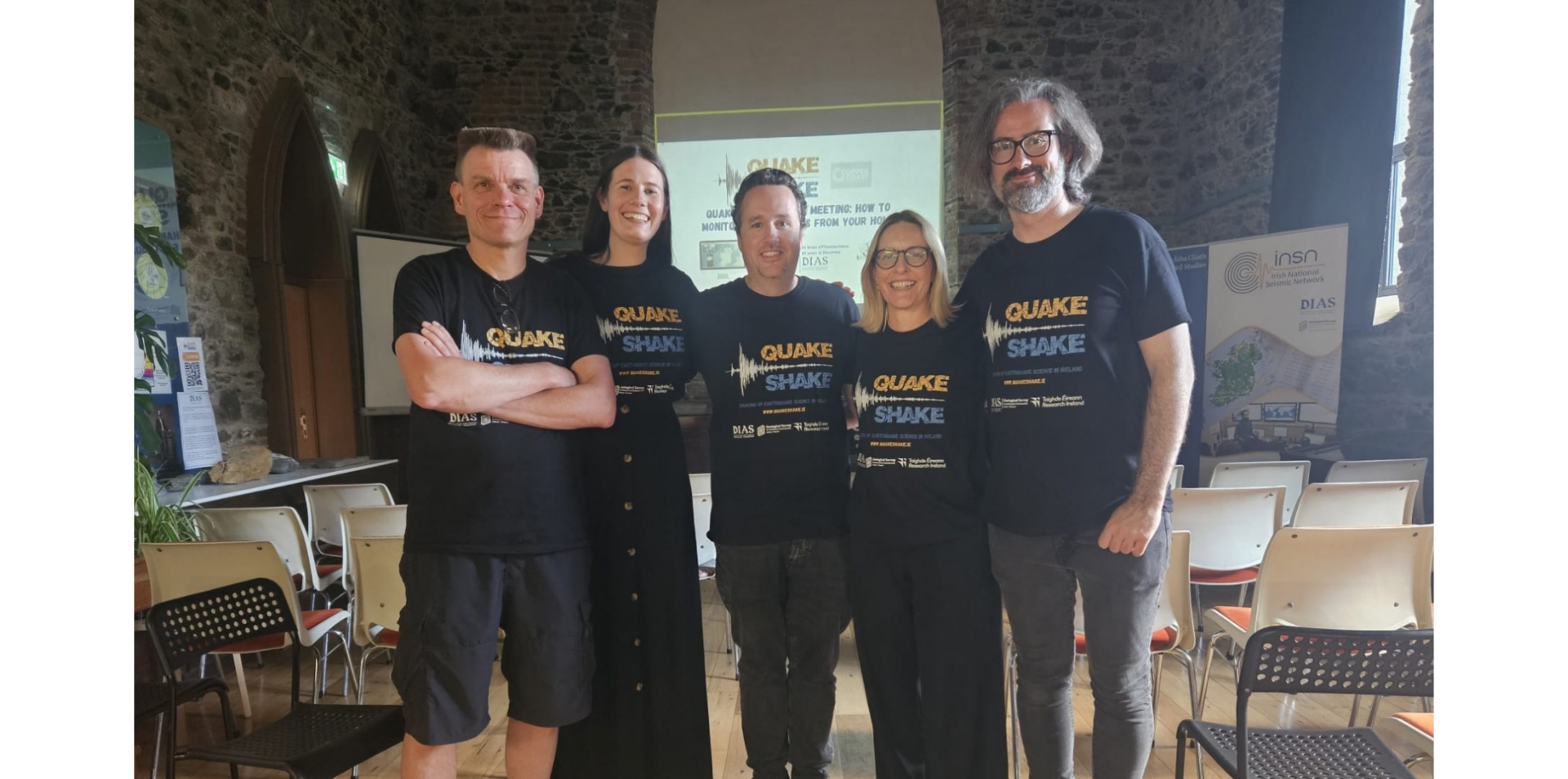
Similar recordings have since been made at other coastal sites, including schools and community spaces. Research Ireland funding supported a public QuakeShake meeting in the Copper Coast Geopark visitor Centre in Bunmahon, Co. Waterford in June 2025 (Fig. 2), where seismometers were raffled to members of the public. The initiative aimed to improve monitoring local earthquakes in south-east Ireland and allow tracking the seasonal return of fin whales along the Waterford coast. By November 2025, fin whale songs had already been detected by the additional seismometers operating across the Copper Coast. This included a station at St James’ National School in Stradbally through a cooperation with An Taisce’s Clean Coasts and Green-Schools programme.
This work has important implications for marine conservation. Fin whales are classified as a vulnerable species, and face increasing threats from human activity, such as ship strikes and entanglement in fishing gear. Understanding where and when these whales are present, particularly in busy coastal waters, is essential for reducing these risks. Monitoring this activity has traditionally been reliant on sightings and on hydrophones – underwater devices that detect and record sound – but operating these instruments is costly and transmitting their data in real time can be challenging. By showing that whale song can also be detected on land, this research expands the options available for monitoring near-costal marine life.
The scalability of this on-land approach is particularly promising. Using publicly available data, DIAS researchers estimate that around 14% of permanent seismic stations and 17.5% of Raspberry Shake instruments are located within 3km of a coastline, amounting to approximately 1,650 sensors worldwide. This existing infrastructure could support large-scale monitoring of fin whale activity and make a real impact in conservation efforts for these sea giants, without the need for massive investment or installation of new infrastructure.
Dr Möllhoff and Prof. Bean’s work also demonstrates how investment in public engagement and engaged research can shape scientific discovery. The QuakeShake network is enabling schools and communities to contribute to real-time seismic data monitoring of earthquakes as well as other environmental processes, linking local participation with ongoing scientific discovery.
The support we received from Research Ireland allowed us to put more than 50 additional citizen science seismometers into the hands of communities across Ireland. These instruments are transforming how we monitor earthquakes, but they are also revealing unexpected signals from our environment. Being able to record fin whale songs from land-based seismic stations shows the incredible potential of citizen science to contribute not only to geophysical but also marine research.
– Dr Martin Möllhoff, Dublin Institute for Advanced Studies (DIAS)
Who is involved?
Dublin Institute for Advanced Studies (DIAS), Geological Survey Ireland (GSI), Irish Whale and Dolphin Group (IWDG), Copper Coast Geopark, An Taisce
The Irish National Seismic Network (INSN) and its outreach component QuakeShake are operated by the Geophysics Section in DIAS, in collaboration with GSI.
Find out more:
Follow QuakeShake and DIAS Geophysics on social media:
Read the paper in Scientific ReportsRead the paper in Scientific Reports Blog post on QuakeShakeBlog post on QuakeShake
Image caption: The QuakeShake team (Martin Möllhoff, Laura Reilly, Paddy Smith, Louise Collins and James Grannell) at the public QuakeShake meeting in June 2025 in the Copper Coast Geopark visitor Centre, Bunmahon, Co. Waterford.