When researchers step out of the laboratory and into the epilepsy clinic
FutureNeuro, the Research Ireland Centre for Translational Brain Science, is helping researchers ground their work in the realities of neurological care, and an international pilot study shows the model is worth scaling.
The best healthcare technologies are not built by looking at clinical data alone; they are shaped by understanding how clinicians work and how patients experience care.
– Shokofeh Anari, FutureNeuro PhD researcher, University of Galway
Laboratory-based research can feel a long way from the clinic. For scientists developing new diagnostics, therapies and technologies for neurological conditions, the day-to-day realities of patient care are not always visible in the data, samples or code they work with. The idea for FutureNeuro’s Researcher Clinic Visit Programme came from Consultant Neurologist Professor Norman Delanty. Prof. Delanty’s idea was simple: bring researchers into the clinic and let them step into the world their research is ultimately intended to benefit. Based at the Epilepsy Outpatient Clinic, Beaumont Hospital, and run through FutureNeuro, the programme gives non-clinical researchers the opportunity to observe consultations and clinical workflows, and to engage directly with clinicians, patients and carers. Prof. Delanty alternates on clinic duty with Consultant Neurologist Dr Hany El-Naggar, who has also hosted and facilitated many researchers during his months in the clinic.
Since the programme began almost three years ago, nearly 40 researchers from across FutureNeuro have taken part, sitting in on epilepsy clinics, observing multidisciplinary clinical teams and hearing directly from patients and families. A recent thematic review of participant reflections found a consistent message: clinical exposure changes researchers’ relationship to their own research. Participants describe moving from an abstract, laboratory-based understanding of epilepsy to a fuller sense of how the condition affects individual patients and families. This is echoed in one researcher’s comment about how individual experiences could depart considerably from the more rigid descriptions of disease encountered in research, giving a much clearer sense of the diversity of real-world epilepsy.
That shift feeds back into the science. Encountering the complexity of clinical care, including diagnostic uncertainty and the trade-offs of medication side effects, prompted several researchers to reconsider what successful treatment looks like beyond seizure control alone. Others described a new appreciation of patients and families as a source of knowledge in their own right, strengthening researchers’ understanding of the value of engaged research and patient and public involvement (PPI). Several also reported renewed motivation, with one researcher describing how the clinic helped her “regain sight of the bigger picture” when experiments, data and papers dominate day-to-day research. For others, meeting patients made the potential impact of their work feel more real and strengthened their sense of purpose.
This value has now been recognised internationally. FutureNeuro researchers took part in a pilot study led by the International League Against Epilepsy (ILAE) Neurobiology Commission, published in Epilepsia Open earlier this year. The study followed 50 researchers across 21 epilepsy centres in 18 countries who were immersed into clinical settings for a two-week period – testing, at international scale, the same approach FutureNeuro has been running at Beaumont since 2023. FutureNeuro Director Prof. David Henshall and Prof. Norman Delanty are among the authors on the paper, and three FutureNeuro postdoctoral researchers (Dr Ifeolutembi Fashina, Dr Mona Heiland and Dr Hamidah Ghani) were among the study’s participants.
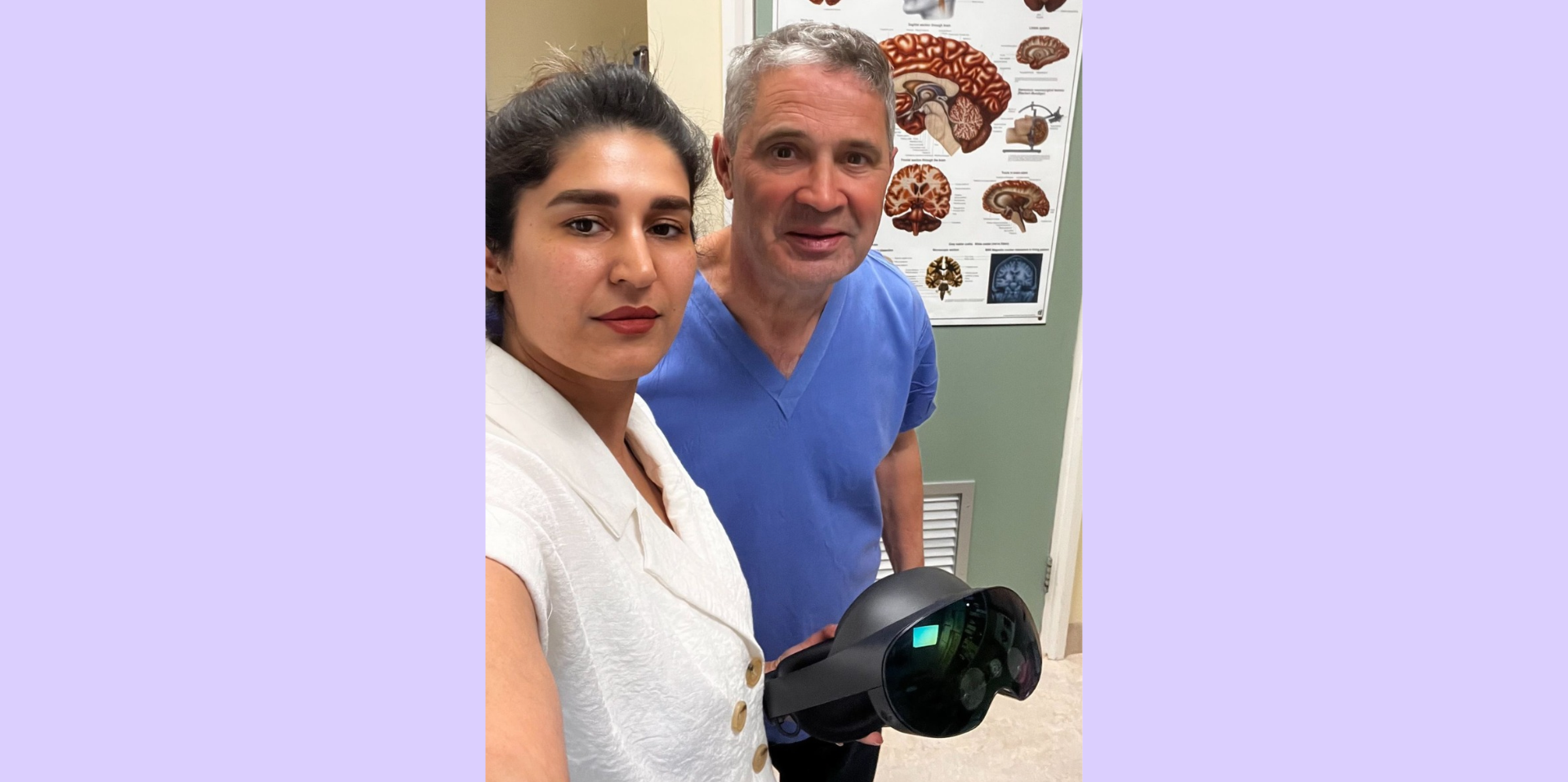
FutureNeuro PhD researcher Shokofeh Anari’s experience shows what that shift can produce in practice. Two days in the Beaumont clinic gave her insight into the realities behind the data she works with, including how EPR data, EEG results and longitudinal clinical records are used in epilepsy care. She also demonstrated an early prototype to Prof. Delanty: a mixed-reality headset designed to bring a patient’s EEG recordings, clinical notes, medication history and 3D neuroimaging into a single navigable space. The clinical feedback helped Anari focus more clearly on the clinical need her technology should address. She has since completed the first development stage of the work, now named ClinicalSphereXR. While the current focus is epilepsy, the longer-term approach could potentially be adapted for other neurological conditions, including Parkinson’s disease and Alzheimer’s disease. ClinicalSphereXR illustrates what the FutureNeuro Researcher Clinic Visit Programme set out to achieve: bringing researchers closer to the people, practice and clinical challenges behind their research, and allowing clinical insight to shape what they develop.
Looking ahead, FutureNeuro will continue to work with the ILAE and build on examples like Anari’s to demonstrate what this approach can produce. For Research Ireland, the programme delivers on several fronts at once: it strengthens Ireland’s international research profile through co-authorship on a global pilot study, it builds translational research capacity among the country’s early-career scientists, and it has already produced a tangible technology output in ClinicalSphereXR. Evidence that this way of working pays off in real innovation. By keeping researchers closely connected to clinicians, patients and carers, FutureNeuro is helping to ensure that the questions being asked stay focused on what matters most: improving outcomes and quality of life for people living with neurological conditions.
Clinicians and scientists interested in patients with challenging and complex epilepsy want fundamentally the same thing – the optimum care of patients and families. I have always been concerned that clinicians and scientists work in parallel universes, rather than understanding more fully what each other does. Over the last three years, my colleagues and I have had 35 basic and translational research scientists visit and observe at our epilepsy clinic on Tuesday mornings at Beaumont Hospital. I think this has given them an insight into the complex medical and psychosocial challenges that patients and families experience and overcome. It gives them a more holistic picture of the lived experience of epilepsy and related disorders.
– Professor Norman Delanty, Clinical Professor, RCSI and Consultant Neurologist, Beaumont Hospital
Who is involved?
FutureNeuro, the Research Ireland Centre for Translational Brain Science; Beaumont Hospital Epilepsy Outpatient Clinic; RCSI University of Medicine and Health Sciences; University of Galway; International League Against Epilepsy (ILAE) Neurobiology Commission.
Image caption: FutureNeuro PhD candidate Shokofeh Anari demonstrates the ClinicalSphereXR prototype to Prof Norman Delanty.