Cara-Lena Nies – Reflections from the 75th Lindau Nobel Laureate Meeting
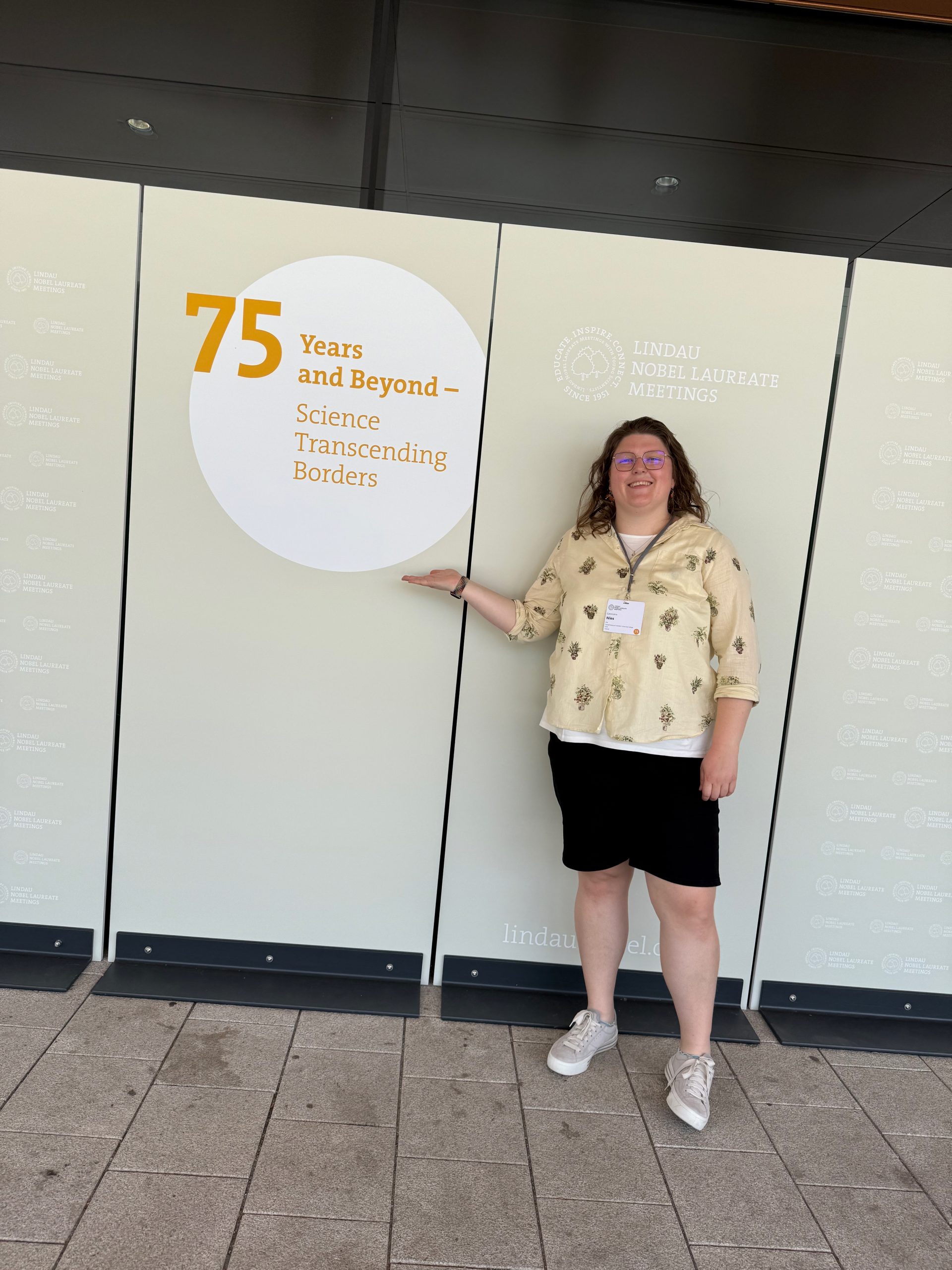
My name is Cara-Lena Nies and I’m a Government of Ireland Postdoctoral Fellow at Tyndall National Institute, University College Cork. My area of expertise is computational materials chemistry, specifically the atomic-s cale modelling of surface chemistries for applications ranging from nanoelectronics and sensing to deposition techniques and catalysis.
My current research focuses on designing new materials to convert NOx pollutants in urban areas. This is an area close to my heart, as NOx pollution contributes to more than seven million premature deaths every year and increases the prevalence of respiratory disease. Current catalysts only remove some harmful nitrogen oxides, while others continue to accumulate. My research aims to design materials that can convert a broader range of these pollutants into harmless nitrogen and oxygen, helping to clean the air in our cities.
Because materials science sits at the interface between chemistry, physics and engineering, interdisciplinary collaboration is central to my work. As a theoretical chemist, I also spend much of my time communicating with colleagues performing laboratory experiments. Although we are working towards the same goals, our approaches and perspectives can be very different. For that reason, the interdisciplinary focus of the 75th Lindau Nobel Laureate Meeting made it a perfect fit for me.
At first, being selected to attend Lindau simply felt like a surreal and incredible opportunity to meet amazing scientists from all over the world, both Nobel Laureates and fellow Young Scientists. But coming up to the meeting, and especially now that I have attended, that meaning has expanded.
I’m at the stage in my career as a postdoc, where you’re looking for more permanent positions and trying to transition towards becoming an independent researcher. At this stage, so much of the focus shifts towards applications, funding and finding permanent positions that it is easy to lose sight of why you’re bothering with research in the first place.
Going to Lindau reminded me why I’m a scientist.
Conversations with Nobel Laureates revealed that, despite their extraordinary achievements, they all share the same passion for understanding the world. That passion drove them to keep asking questions and researching their chosen topics until they truly understood them. At the same time, conversations with my fellow Young Scientists showed that many of us share the same worries and uncertainties about building a career in academia. I came back from Lindau feeling more determined – and much less alone – than I did a few weeks earlier.
As you might imagine, it can be difficult to simply walk up to a Nobel Laureate and introduce yourself. One of the things Lindau does exceptionally well is to create opportunities that make those conversations feel natural. Alongside lectures and panel discussions, there are informal sessions such as the Nobel Hour, where a single Laureate makes themselves available to answer questions from participants.
As you might imagine, it can be difficult to simply walk up to a Nobel Laureate and introduce yourself. One of the things Lindau does exceptionally well is to create opportunities that make those conversations feel natural. Alongside lectures and panel discussions, there are informal sessions such as the Nobel Hour, where a single Laureate makes themselves available to answer questions from participants.
One of the highlights for me was the Nobel Hour with Saul Perlmutter. Although he received the Nobel Prize in Physics, much of his work today focuses on teaching scientific thinking to high school students and university undergraduates across all disciplines. His enthusiasm for helping people think critically about evidence, uncertainty and decision-making was infectious, and I came away convinced that this is an area that could make a real difference to education.
Even more memorable were the opportunities to spend time with Nobel Laureates in much smaller groups. Throughout the week, participants could sign up for lunches or walks with a Laureate, usually in groups of around ten people. I was fortunate enough to have lunch with Jean-Marie Lehn. What was meant to be a short lunch turned into a much longer conversation about life as a scientist, what motivates us, and how to pursue genuinely original research without simply following the latest bandwagon. Even more importantly, Jean-Marie Lehn bought us ice cream for dessert – it really hit the spot on a hot June day!
Another memorable conversation was with Michael Levitt, one of the very few Nobel Laureates whose Prize recognised work in atomic-scale modelling. Naturally, I was especially keen to speak with him. Although we ended up having a fascinating discussion about the promise and potential of AI in research, what stayed with me most was our conversation about women in science and the importance of visible women role models for the next generation of researchers.
I was also fortunate to attend the Freedom of Research discussion with former German Chancellor Angela Merkel. It prompted me to reflect on the close relationship between science, politics and society, and the responsibility researchers have. Those reflections are something I know will stay with me for years to come.
Meeting fellow early-career researchers was just as rewarding as meeting the Nobel Laureates. I had not expected such a wide range of career stages, from undergraduate students to researchers who had only recently started independent academic positions. Since this was the interdisciplinary meeting, it was also fascinating to hear about the breadth of research being carried out around the world.
Most importantly, however, it was the chance to connect with people who were working in completely different fields but facing many of the same questions. What’s the best university or country for me? Should I join a prestigious lab, or would I thrive more in a smaller group? Should I stay in academia? How can we use AI responsibly? How can we ensure that society listens when science has something important to say?
We didn’t find definitive answers to those questions, but it was reassuring to realise that we are all asking them together.
Looking back, the whole week was inspiring. I was particularly struck by how many Nobel Laureates use the platform their Prize has given them to address global challenges beyond their own research. Lindau itself was founded after the Second World War to foster peace through international scientific collaboration, and that spirit remains just as strong 75 years later.
I arrived at Lindau expecting to learn from Nobel Laureates. I left with something much more valuable: a renewed sense of why I chose a career in research, and a community of scientists from around the world who share that same curiosity and commitment. At a time when science faces enormous global challenges, Lindau reminded me that progress doesn’t happen in isolation – we can only solve these challenges by working together.
Many of the sessions from this year’s meeting are available online through the Lindau Nobel Laureate Meeting website. I would particularly recommend the “Follow-up on the Mainau Declaration” discussion and Katalin Karikó’s lecture.