Culture, Creativity & Inclusive Society: EU successes for Irish-based research projects
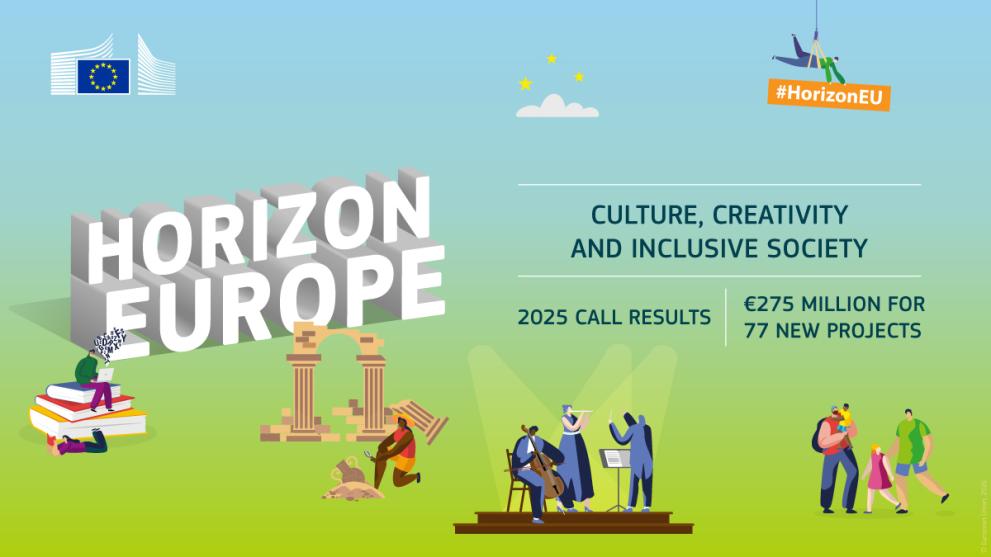
Irish-based researchers and practitioners have been successful in the recently announced Horizon Europe Cluster 2: Culture, Creativity and Inclusive Society funding call results from the European Commission.
Of the 77 projects to receive funding, 15 involve Irish-based researchers, who have secured almost €5.5million.
These participants come from Irish universities, charities, museums and SMEs, and their projects focus on such diverse topics as AI-adapted textbooks to assist primary school children with dyspraxia; peacebuilding through the arts in conflict-impacted societies; and the implications of changing working hours and practices.
Projects in the Horizon Europe Cluster 2: Culture, Creativity and Inclusive Society area are large-scale endeavours, blending a range of disciplines and sectors and taking an international approach across Europe and further afield.
They deal with challenges and opportunities for European societies, with a particular focus on themes of democracy, cultural heritage and creative industries, and socio-economic transformations and the worlds of work and education.
Funded Projects
WOTAM: WOrking Time Acceptance Model
WOTAM aims to understand the mechanisms, conditions, drivers, barriers and debates that shape working-time reduction across different sectors and regions in Europe. Rather than asking simply whether reduction works or does not work, the project will explain why it is accepted, resisted or implemented differently across contexts, giving Ireland and Europe a stronger evidence base for future workplace and policy discussions.
Professor Na Fu, of Trinity College Dublin (TCD), explained that the funding allows us to understand the Irish experience in comparison with very different labour-market, institutional and cultural contexts across Europe, rather than studying Ireland in isolation. It enables cross-country data, case studies and collaboration with researchers, employers, unions and policymakers at a scale that would be very difficult through national funding alone, while bringing European knowledge and networks directly back into the Irish research and policy environment.
As well as TCD, the project will also involve IBEC, the ERSI, and ICTU. Having a strong group of Irish partners allows the team to examine the issue from different perspectives: ESRI contributes labour-market and economic expertise, IBEC brings the employer and competitiveness perspective. ICTU helps to broaden the research across regions, sectors and different types of organisations. Together with TCD’s expertise in human resource management, digital transformation, work and organisational research, this strengthens the Irish contribution and helps ensure that Ireland has a strong voice within the wider European research and policy conversation.
Lab2School4All
Led in Ireland by Dr Mellissa Prunty, of University of Limerick, the aim of Lab2School4All is to enable primary school children with Developmental Coordination Disorder (DCD – also known as dyspraxia) to use adapted textbooks independently in the classroom. Using an AI-powered automation pipeline, standard textbooks will be transformed into adapted digital versions that preserve the original exercises but remove visuo-spatial barriers.
Involving a wide range of Irish teachers, parents, occupational therapists, children and young adults, This European funding provides a valuable opportunity to ensure that core textbooks used by children aged 9-11 in Ireland, including Irish-language texts, are represented in cutting-edge international research, creating direct relevance and impact for Irish education. It also enables large-scale scientific investigation of important literacy questions, such as the relative benefits of handwriting, typing, and scribing for writing performance, generating evidence that can inform educational practice and policy in Ireland.
CIRCLE
The CIRCLE peacebuilding project aims to bring together, through the arts, peacebuilding and interfaith dialogue experts and practitioners with experience working with youth living in conflict, frozen-conflict, or post-conflict societies. This will lead to in-person, intercultural and interfaith partnerships working together to create and sustain peaceful, creative and dialogical initiatives for youth at local, regional, and international levels. With NGOs, Universities, Museums and Theatre partners from across Europe, there is rich interdisciplinary, interreligious, academic, creative arts, and on-the-ground expertise in conflict and peacebuilding, interfaith dialogue, and projects involving youth that can be applied in diverse European contexts.
Dr Peter Admirand of Dublin City University, who is a Principal Investigator on the project, explained the benefit of European funding of this nature:
Long-term, in-person, regional and international group projects like CIRCLE would simply not be possible without EU funding like this. In our first meeting, hearing stories and testimonies from those in conflict – the Ukrainian partner having to stop her talk as her city was being attacked by drones while we were discussing peaceful responses to conflict – forces tough questions and real responses. It also strengthens international connections and matures perspectives because of the depth and breadth of the group.
One of the strengths of this project is the cross-institutional, discipline, religious, and national contexts, including art and museum institutes like the Chester Beatty involved in youth education initiatives or the work of the North Play Centre in light of The Troubles and ongoing societal unrest. The arts are essential partners and voices in working to create further formats, toolkits, and programmes that emphasize non-violence and dialogue through inclusive youth outreach and partnerships.
A full list of awards with Irish partners can be found in the below excel document:
Participation in these projects will enable Irish researchers to engage internationally and across a wide range of sectors, to influence European policy and practices, and to boost the capacities of Irish research ensuring that we are at the forefront of European research and innovation in these areas.
Some of the projects have already commenced, with others scheduled to kick off before the end of the year. Applicants to the 2026 calls have recently made their final submissions.