STEM Passport for Inclusion Launched in Northern Ireland by Queen’s University Belfast and Maynooth University
Queen’s University Belfast today celebrated the launch of the STEM Passport for Inclusion in Northern Ireland – a programme designed to address inequalities in access to science, technology, engineering and maths (STEM) education for young people from under-served backgrounds.
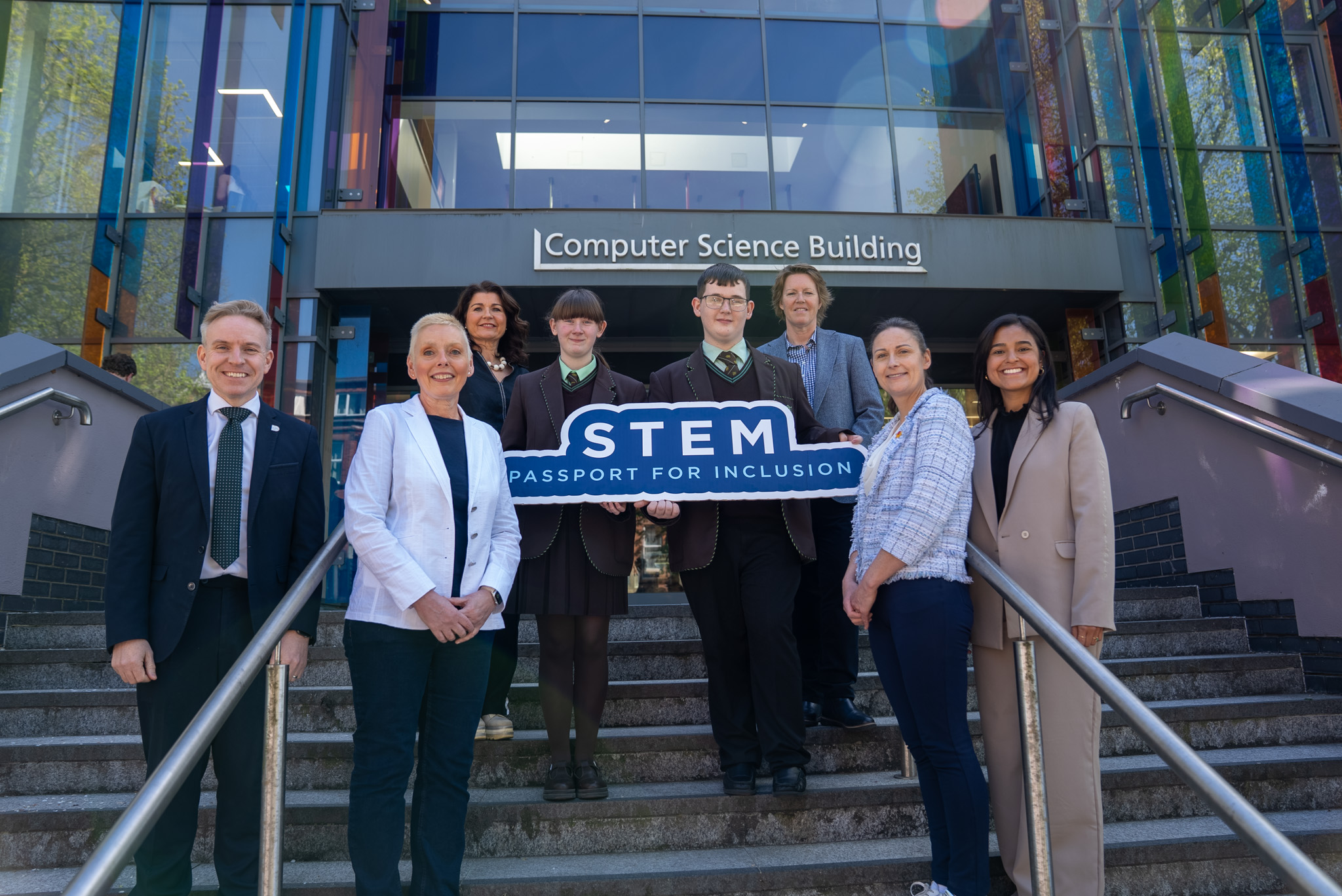
Students from St Louise’s Comprehensive College in west Belfast became the first northern cohort to complete the programme, which will see them complete a Level 4 RFQ qualification accredited by Queen’s.
Funded through the Research Ireland Discover programme, the initiative is set to expand in the new academic year to a full cross-border rollout, when up to 150 pupils from schools across Northern Ireland will take part.
STEM Passport for Inclusion is an initiative led by Professor Katriona O’Sullivan at Maynooth University’s National Centre for Inclusive Higher Education and delivered in partnership with founding industry partner Microsoft. The programme is funded by Research Ireland, the Department of Education and Youth and Microsoft, as well as by many industry and education partners. It aims to tackle persistent inequalities in access to STEM education and career pathways, with particular focus on growing representation of under-served communities.
Since its launch in 2021, the programme has supported more than 10,000 students across the Republic of Ireland, combining skills development and mentoring with higher education and industry.
Funding through the Research Ireland Discover Programme has allowed Maynooth and Queen’s Universities to work in partnership to bring the programme to Belfast with plans set to expand the initiative across Northern Ireland.
Queen’s President and Vice-Chancellor, Professor Sir Ian Greer, said of the programme:
Queen’s Civic Mission outlines our deep commitment to ensuring that talent and opportunity are not limited by circumstance. The launch of the STEM Passport for Inclusion here in Northern Ireland represents an important step in continuing to break down barriers to STEM education and careers.
We are proud to work alongside colleagues in Maynooth University and across the Secondary Education sector in supporting young people, who may not otherwise have the exposure to STEM fields, to realise their potential. I offer my gratitude and congratulations to the staff and pupils at St Lousie’s not only for completing the project, but also for making this pilot phase possible.
Dr Rachel Iredale, Head of Public Engagement for Research Ireland, said:
We are delighted to see the expansion of the STEM Passport for Inclusion to Belfast. This initiative is so important in ensuring that all young people across the island of Ireland are provided the same opportunities and access to STEM and we are happy to support it through the Research Ireland Discover Programme.
Professor Katriona O’Sullivan, founder of the STEM Passport for Inclusion and Director of Maynooth University’s Centre for Inclusive Higher Education said:
Expanding STEM Passport across the island of Ireland has always been a strategic goal of the programme, ensuring equality of access for students from all backgrounds. We are delighted with the success of the pilot in Belfast with St. Louise’s Comprehensive School and are looking forward to working with more schools across Northern Ireland as we continue to expand and grow.
The pilot programme with St Louise’s Comprehensive College focused on building confidence, awareness and skills among pupils. Access to university-led learning from Queen’s academics, along with mentors from range of sectors within the STEM space, including construction, consulting and tech companies, allowed them to explore a wide range of STEM pathways and career opportunities.
Cora O’Hagan, a pupil at St Louise’s Comprehensive College said:
Before taking part, I hadn’t really thought much about STEM and wasn’t sure if it was something I’d be interested in. The programme allowed me to see different careers I didn’t know about and made me realise there are so many options and opportunities out there for me.
Photo caption: Pictured (l-r) at Queen’s Computer Science building: Professor Margaret Topping and Dr Ryan Feeney (Queen’s University, Belfast); Dr Gemma Irvine and Isabel Meza (Maynooth University); Professor Helen McCarthy (Northern Ireland Executive Office); and St Louise’s pupils Aoife Clarke and Odhran Sullivan with the school’s Head of Technology and Design, Mrs Mackey