MSCA COFUND success for three Ireland-based early career training programmes
Three Ireland-based organisations have been selected for funding for large-scale researcher training programmes under the 2026 Marie Skłodowska-Curie Actions (MSCA) COFUND call.
With only 29 proposals selected across Europe, this result places Ireland among the strongest performing countries in this year’s call.
The MSCA COFUND call invites organisations to seek co-financing from the EU for the delivery of PhD or postdoctoral training programmes which leverage existing regional, national or international funding.
Through the 2026 call, the European Commission will provide €105.5 million to fund 29 programmes, 15 doctoral training programmes and 14 postdoctoral fellowship programmes. In total, 141 proposals were submitted from organisations across Europe, of which 136 were evaluated, giving an overall success rate of 21%.
Ireland submitted four proposals to the call and three were selected for funding*, a success rate of 75% and more than one in ten of all programmes funded across Europe.
With a proposed drawdown of over €14 million across the three programmes, this is a significant outcome for Ireland and reflects both the quality of the training programmes designed and the depth of institutional support behind them. Two of the three successful programmes leverage funding already committed by Research Ireland showing the importance of national investment that allows organisations to compete, and win, against the best in Europe.
The benefits extend well beyond the awardee organisations. The prestige of these MSCA co-funded programmes will attract top international doctoral candidates and postdoctoral research talent into Ireland on internationally competitive terms, strengthening a diverse and mobile research base, nurturing the skills and experience needed for the future workforce across a diverse range of career pathways.
Commenting on Ireland’s performance in the call, Dr Diarmuid O’Brien, CEO of Research Ireland, said:
What distinguishes COFUND is not the money alone, but the conditions attached to it: funding is only awarded to institutions which will deliver world-class research and training programmes, operating on the principles of open, transparent and merit-based international recruitment, excellent supervision and working/employment conditions, and supportive career development. Coming in the year that marks the 30th anniversary of the MSCA, and as Ireland prepares to host the MSCA Presidency Conference in TU Dublin on November 4th and 5th, it is a timely endorsement of Ireland’s standing in Europe’s flagship programme for research talent.
The Funded Projects:
Professor Cathal Seoighe, University of Galway – AI and Modelling to Accelerate Cellular Therapeutics (AIM2ACT):
Advanced cellular immune therapies (ACITs) are rapidly emerging as a major new class of treatments with potential for highly personalised and durable clinical benefit. Their development, however, remains technically demanding and requires researchers who can integrate computational modelling, data analytics and artificial intelligence with core expertise in immunology, cell engineering, bioprocessing, regulatory science and clinical research.
AIM2ACT is a doctoral training programme designed to develop researchers who can operate at this interface. The programme will train 30 doctoral candidates to build and apply computational and AI-based tools across the full cellular-therapy development pipeline, spanning early design, laboratory optimisation, manufacturing, regulatory assessment, clinical evaluation and patient-focused considerations. This integrated approach addresses a recognised skills gap, as the next generation of cell therapies will rely on the coordinated use of both experimental and computational-driven methods.
Through structured interdisciplinary training, exposure to laboratory and computational environments, and intersectoral experience with industrial, clinical and regulatory partners, AIM2ACT researchers will gain the scientific and technical skills needed to connect biological knowledge with quantitative modelling and AI-supported decision-making. Complementary training in research communication, project management and responsible innovation will further support their development as independent scientists.
By producing researchers with combined biological and computational expertise, AIM2ACT aims to contribute to Europe’s capacity to develop personalised cellular therapies and to support the wider use of AI-enabled approaches across therapeutic development.
AIM2ACT is all about training young researchers to work together in teams across the multiple disciplines that contribute to the development of new medicines. Through a partnership with the Research Ireland newly-established Rinn Advanced Therapies, PhD students will be trained to apply advances in AI and modelling across the whole development process to accelerate the discovery, translation and implementation of new cell-based therapies.
Professor Pepijn van de Ven, University of Limerick – Postgraduate Research Education Programme in Artificial Intelligence Readiness (PREPAIR):
Various EU initiatives have identified the lack of Artificial Intelligence (AI) expertise in the European workforce as a serious threat to the EU’s ability to play a world-leading role in AI. PREPAIR, a university wide doctoral training programme proposed by the University of Limerick (UL) with 40 cross sectoral and international partners, will train a new generation of researchers capable of advancing responsible, trustworthy and societally aligned AI.
PREPAIR will train fellows who demonstrate research excellence and autonomy, strong AI technical skills, career readiness, cross disciplinary and cross sectoral exposure, and excellent competencies in ethics, sustainability, integrity and Open Science. In a doctoral training programme fully aligned with EU principles for Innovative Doctoral Training, PREPAIR will support 38 international doctoral candidates (DCs) completing 48-month PhD projects.
Through MSCA aligned cross-disciplinary and cross-sectoral supervision, programme wide activities, secondments and 30 ECTS of structured transferable and scientific training, DCs will engage with expertise across all themes and acquire skills identified by industry as essential. This ensures that DCs are prepared for impactful careers across industry, government and academia. PREPAIR will deliver researcher centred, international, interdisciplinary and intersectoral training; embedding Open Science and research integrity; and contributing to Europe’s talent needs for the digital and green transitions.
PREPAIR is about ensuring that Europe not only develops and uses more AI, but better AI. This funding enables the University of Limerick and our partners to train a new generation of researchers who can advance AI that is technically excellent, ethically grounded, sustainable, and aligned with the needs of society. At the same time, it allows us to further strengthen UL as a destination of choice for doctoral education, giving talented researchers the skills, networks, and experience they need to create real-world impact in the years ahead.
Professor Walter Kolch, University College Dublin – COMPutational modelling Across Systems and Scales: Postdoctoral Opportunities for Interdisciplinary and Networked Training (COMPASS-POINT):
Rapid advances in artificial intelligence, data science and systems modelling have created unprecedented opportunities to understand and intervene in complex biological and biomedical systems. Yet expertise remains fragmented across traditional domains, and there is a critical shortage of scientists capable of integrating computational modelling with experimental, clinical and translational research.
COMPutational modelling Across Systems and Scales: Postdoctoral Opportunities for Interdisciplinary and Networked Training (COMPASS-POINT) is an innovative programme designed to address this capacity gap in the life sciences and biomedicine. The programme will provide interdisciplinary training and structured intersectoral mobility within a research-intensive, collaborative environment that equally values methodological rigour, innovation and real-world impact. Competitive international calls will recruit outstanding incoming postdoctoral fellows in computational, statistical and mathematical sciences.
COMPASS-POINT will generate a diverse, mobile and highly skilled workforce capable of addressing major societal challenges in health and disease. By embedding computational excellence within interdisciplinary biomedical research ecosystems, the programme will strengthen European research capacity, enhance innovation potential and support sustainable, knowledge-driven economic growth.
COMPASS-POINT represents a significant opportunity for University College Dublin (UCD) to build capacity in computational modelling, AI and data science across biological and biomedical research. In developing this programme with partners across the University, Systems Biology Ireland (SBI) is helping to build a community of researchers with the interdisciplinary skills needed to tackle increasingly complex challenges in medicine. These skills are essential to the success of major strategic initiatives, such as the Research Ireland-supported Precision Oncology Ireland, which is using data-driven approaches to transform cancer research and healthcare.
* These statistics are subject to change and will only be confirmed once the grant agreements are signed with all the projects concerned.
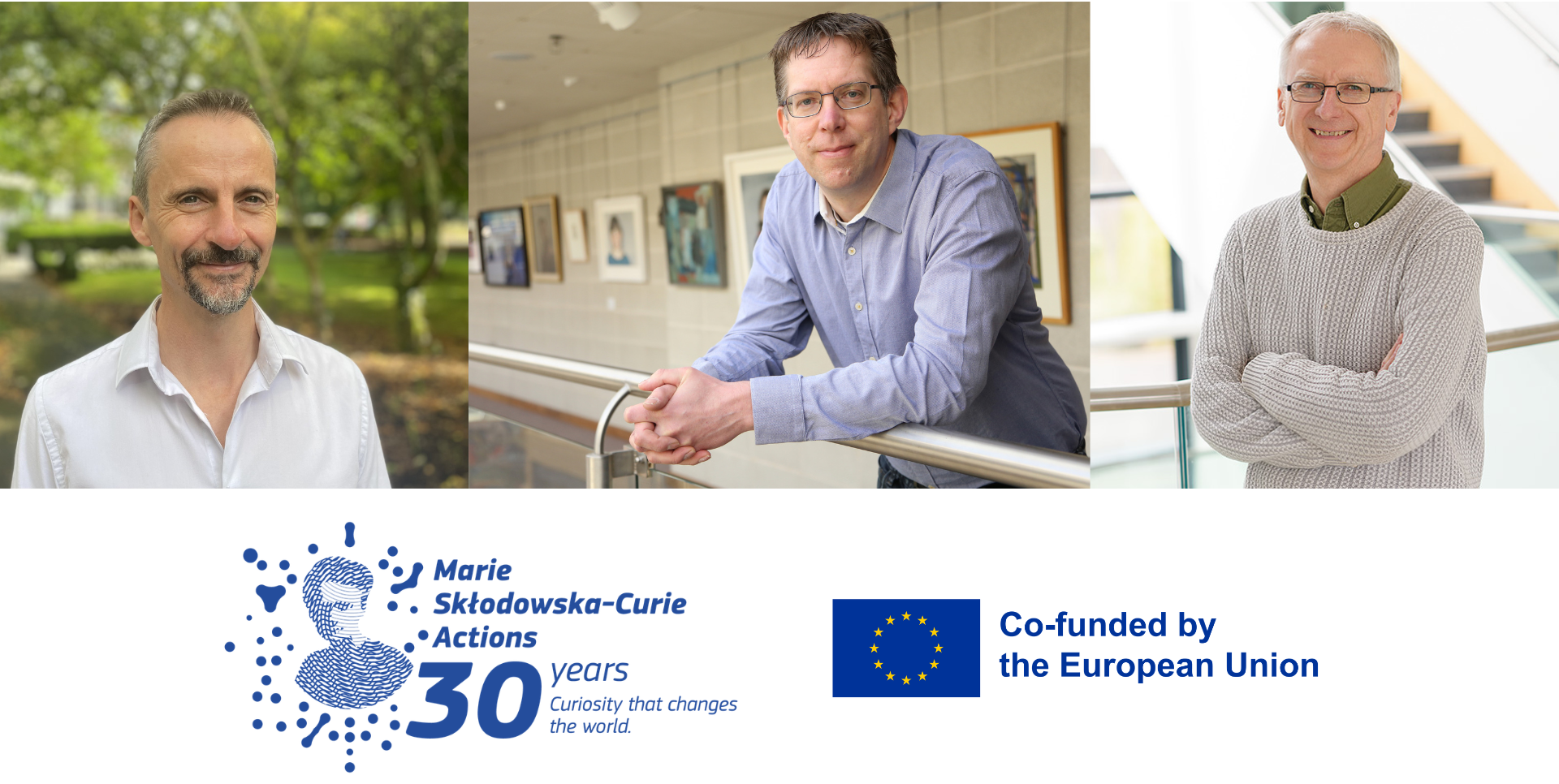
Photo caption: Pictured (left-right): Professor Cathal Seoighe, Professor Pepijn van de Ven, and Professor Walter Kolch