Five Ireland-based researchers awarded prestigious ERC Advanced Grants
Five Ireland-based researchers have today been awarded European Research Council (ERC) Advanced Grants, among Europe’s most prestigious and competitive awards for established research leaders. Their success recognises outstanding achievement, bold scientific ambition and the power of curiosity-driven research to open new frontiers of knowledge.
The five new ERC Advanced Grant awardees based in Ireland are Professor Porscha Fermanis, University College Dublin (UCD); Professor Richard Layte, Trinity College Dublin (TCD); Associate Professor Rory Johnson, UCD; Professor Anthony O’Mullane, UCD; and Professor Rhodri Cusack, TCD. Their research spans the Social Sciences and Humanities, Life Sciences, and Physical Sciences and Engineering, reflecting the breadth, quality and international competitiveness of Ireland-based research.
Dr Diarmuid O’Brien, Chief Executive of Research Ireland, said:
ERC Advanced Grants back research leaders with the courage to ask the biggest questions and the ambition to pursue answers that can change how we understand the world. I warmly congratulate Professors Porscha Fermanis, Richard Layte, Rory Johnson, Anthony O’Mullane and Rhodri Cusack on this exceptional achievement. Their success is a powerful endorsement of the calibre of research being carried out in Ireland, and of the sustained investment in people, ideas and infrastructure that allows excellent research to flourish. As Ireland welcomes the ERC Scientific Council this week, these awards are a timely reminder that frontier research is not a luxury; it is the foundation of future discovery, innovation and progress.
The announcement comes at a particularly fitting moment. Tomorrow, Research Ireland – the national competitive research and innovation agency and Ireland’s National Delegate and National Contact Point for the ERC – will welcome Professor Maria Leptin, President of the European Research Council, and members of the ERC Scientific Council to Dublin for the Forum on the Future and Impact of European Research, Science and Technology, taking place during the Council’s visit to Ireland.
The ERC Scientific Council will meet with Ireland-based ERC awardees, researchers, policymakers, industry leaders and national stakeholders to reflect on the future of European research, scholarship and innovation.
2025 ERC Advanced Grant awardees
Professor Porscha Fermanis, UCD
Professor Porscha Fermanis, UCD School of English, Drama and Film, has been awarded ERC Advanced Grant funding for PanAsia – Anticolonialism, Pan-Asianism, and Periodical Culture in Southeast Asia, c. 1850–1920. The project is the first systematic analysis of the newspapers, journals and magazines of nineteenth- and early twentieth-century Southeast Asia.
With ERC Advanced Grant funding, PanAsia will examine periodical culture across three European empires and five interconnected port cities, investigating how cooperative cultural endeavours between different ethnic groups laid the groundwork for the future decolonisation of Southeast Asia.
Professor Fermanis said, “I’m delighted to receive this award and hope that it will result in a multilingual periodical database that will be a resource for scholars of Southeast Asian literary and cultural history for years to come. I also hope that the project’s focus on grassroots anticolonialism will result in the recovery of little-known literary texts and bring to the centre previously marginalised vernacular voices from diasporic and minority communities, serving as a prompt for further archival recovery projects in the region.”
Professor Richard Layte, TCD
Professor Richard Layte of the Department of Sociology at Trinity College Dublin has been awarded ERC Advanced Grant funding for the Flourish project. The project explores the proverb that “it takes a village to raise a child”, examining how relationships with parents, siblings, peers, friends, schools and neighbourhoods contribute to health, wealth and happiness. Until recently, it has not been possible to investigate how different kinds of social relationships interact in the development of the self, or the mechanisms through which they do so.
Flourish will use data on almost 100,000 individuals from four countries, followed from infancy to early adulthood, to understand how social connections shape development and the consequences for mental well-being, educational outcomes and the adoption of harmful health behaviours. The project combines statistical research with qualitative observation of, and interviews with, adolescents in schools in Ireland to develop a rich understanding of the role of social connection in development and well-being.
Professor Layte commented: “This funding will support a programme of research which will test fundamental theories about the development of the self in childhood and adolescence and create new interventions to help all to flourish in life.”
Associate Professor Rory Johnson, UCD
Associate Professor Rory Johnson, UCD School of Medicine, has been awarded ERC Advanced Grant funding for REVOLVER – Directed Evolution to Understand and Engineer Bioactive Long Noncoding RNAs. The project will explore the therapeutic potential of regulatory RNAs, the so-called “Dark Matter” of the genome, and develop new approaches to engineering RNA medicines.
Backed by ERC Advanced Grant funding, REVOLVER will harness the fundamental force of life, evolution, to select enhanced RNAs that can protect cells against disease. The project has the potential to open new avenues for treating liver disease, cancer and neurodegeneration, while also deepening understanding of how natural selection has shaped RNA in the genome.
Associate Professor Johnson said, “The ‘Dark Matter’ of our genome holds huge potential in medicine, but we lack the experimental tools to exploit it. I’m delighted that this ERC award will give me the chance to change that, by harnessing evolution to create RNA medicines that could transform how we treat disease.”
Professor Anthony O’Mullane, UCD
Professor Anthony O’Mullane has been awarded ERC Advanced Grant funding for ALMERS – Adaptive Liquid Metal Electrocatalytic Reaction Systems. The project will develop a new generation of catalysts based on liquid metals that can adapt, self-heal and be controlled during operation.
Unlike conventional catalysts, whose surfaces are fixed and often deactivate, liquid metal catalysts can be reconfigured continuously, opening new possibilities for sustainable chemical manufacturing and environmental remediation. The project will investigate how these materials can be used to convert carbon dioxide into useful products, produce ammonia and urea more sustainably, and break down PFAS “forever chemicals” that contaminate water supplies.
Professor O’Mullane said, “Many of the technologies needed for a sustainable future depend on discovering better catalysts. Liquid metal electrocatalysis is an emerging field that offers entirely new possibilities because these materials can adapt and regenerate themselves while operating. This ERC Advanced Grant provides the freedom and scale needed to explore these ideas at a fundamental level with the potential to influence clean energy, sustainable manufacturing and environmental remediation.”
Professor Rhodri Cusack, TCD
Professor Rhodri Cusack, Thomas Mitchell Professor of Cognitive Neuroscience at TCD and Trinity College Institute of Neuroscience, has been awarded ERC Advanced Grant funding for InfantNeuroAI – Development of Visual Cognition in Infants and Machines.
InfantNeuroAI will investigate how human infants learn to recognise people, objects, actions and relationships during the first year of life. The project combines pioneering methods for studying the awake infant brain, including functional MRI and optically pumped magnetometer magnetoencephalography, with computational models of learning.
The project builds on a series of Research Ireland investments in the Trinity College Institute of Neuroscience, including national research infrastructure support, Frontiers for the Future funding and key advanced computing infrastructure, including a GPU-accelerated computing cluster. This is Professor Cusack’s second ERC Advanced Grant, following the ERC-funded FOUNDCOG project.
Professor Cusack said, “I am deeply honoured to receive an ERC Advanced Grant. The ERC provides a unique opportunity to pursue ambitious, curiosity-driven research that would be difficult to support through other funding mechanisms.
This project builds on capabilities that have been developed over many years through Research Ireland support, including investments in advanced neuroimaging infrastructure, a GPU-accelerated computing cluster, and new methods for studying the awake infant brain. The ERC award will allow us to bring these elements together to investigate one of the most fundamental questions in cognitive science: how human infants learn to make sense of the visual world.
By combining cutting-edge neuroimaging with computational modelling, we hope to uncover the principles that allow infants to learn so efficiently, advancing our understanding of early cognitive development and intelligent learning more broadly.”
A week to celebrate Irish ERC excellence
ERC Advanced Grants are awarded to established research leaders with a recognised track record of significant research achievement. Success in this competition is a mark of exceptional international standing and confirms the strength of Ireland’s research base across disciplines.
Research Ireland congratulates each of the new Advanced Grant awardees and their institutions on this outstanding success. Their achievements will be celebrated alongside the wider community of Ireland-based ERC awardees as Ireland welcomes the ERC Scientific Council this week. Together, these moments demonstrate the value of sustained national investment in excellent research, from early career support and frontier investigator-led funding to advanced research infrastructure, including neuroimaging and GPU-accelerated computing, and major collaborative centres. They also underline the importance of the ERC as a cornerstone of Europe’s research and innovation landscape, supporting ambitious ideas, scientific leadership and excellence without borders.
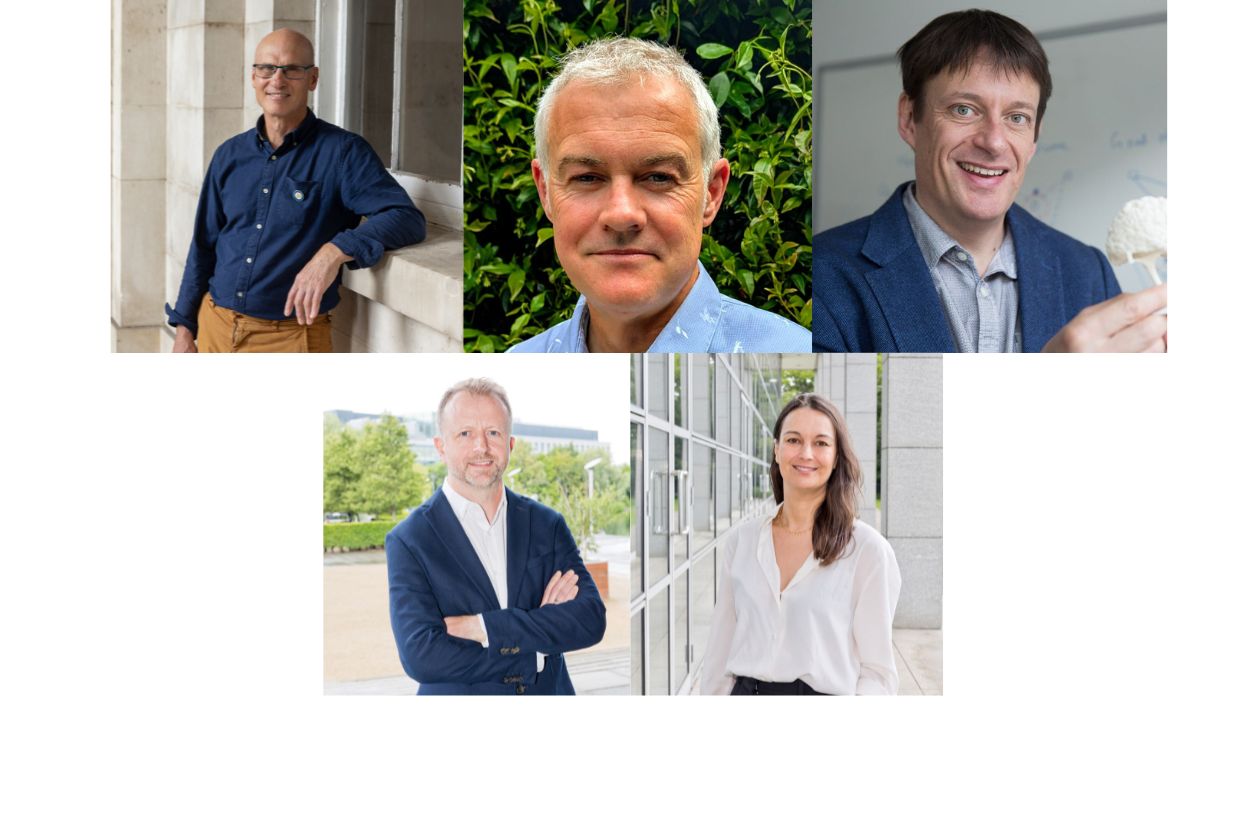
Photo caption: Pictured (l-r): Professor Richard Layte, Professor Anthony O’Mullane, Professor Rhodri Cusack, Associate Professor Rory Johnson, and Professor Porscha Fermanis.