Could virtual reality workspaces help us build strong relationships at work?

By Anna Keller
It’s 9am and you’re logging into your first online meeting of the day. People’s faces begin to appear, some looking already distracted. For the next hour, you are going to communicate and collaborate entirely through this screen. But here’s the question: are you really connecting with your colleagues or are those relationships quietly eroding?
As more organisations in Ireland push for a return to the office, one of the main reasons cited is the need to rebuild workplace relationships. The Bank of Ireland, for example, recently mandated more in-office time, citing that “face-to-face interaction helps work and output, innovation and problem solving”.
But what if there’s another way?
Why relationships matter at work
Workplace relationships are more than just friendly chats, they’re the foundation of collaboration, creativity and trust. Researchers call this “social capital”: the we get from the relationships we have with our co-workers and that value is often in the form of knowledge sharing and idea generation. Things that are harder to replicate online.
Video conferencing tools like Zoom and Microsoft Teams have helped us stay connected, but they come with limitations. Studies suggests that remote workers often experience relationship building barriers when interacting via technology such as reduced social talk and a lack of nonverbal cues such as facial expressions or gestures when the camera is off. Even when cameras are on, people report feeling uncomfortable being the focus of the lens, getting distracted by their own image, by the environment around them or other work on their pc and are therefore, not fully engaged in the conversation.
However, the dichotomous argument of whether relationships are better kindled online or in the office ignores a new option that is now available for virtual communication, and that is through virtual reality immersive workspaces.
Enter virtual reality immersive workspaces
Virtual reality (VR) immersive workspaces offer a new way to meet and collaborate. Using headsets like Meta Quest or PICO, users enter virtual meeting rooms such as boardrooms, auditoriums, or casual spaces where they’re represented by avatars that can speak, gesture and move around.
Unlike video calls, VR meetings allow for more natural movement and interaction. Some users report feeling psychologically and physically present with others, similar to face-to-face encounters. This sense of presence could be key to rebuilding the kind of relationships that drive successful work outcomes.
Solid evidence is yet to be confirmed as very few organisations are using VR for everyday work. While companies like Accenture have experimented with VR onboarding, giving it a 4.7/5 rating for engagement, widespread adoption is still limited. As technology improvements are made, the cost of VR headsets is reducing, from greater than €1000 down to around €500. This is less than the cost of some mobile phones.
Could VR help us connect better?
Research is still ongoing, but early studies suggest that VR could offer a middle ground between remote and in-person work. In gaming environments, for example, social capital can exist in virtual spaces particularly in games where teamwork is required to win or get ahead. Similarly, university students using mixed reality campuses reported feeling present with others and forming relationships based on reciprocity and trust.
In traditional video calls, turning the camera on has been linked to higher levels of trust and stronger social norms. VR could take this a step further by offering richer communication cues and more immersive interactions.
What’s next for Ireland?
As Irish organisations continue to navigate hybrid work models, VR immersive workspaces could be an “in-between” place to meet and interact, rather than the polarising requirements to be fully in the office or fully at home. They might be especially useful for onboarding, brainstorming, or team-building sessions where connection matters most.
At DCU Business School and the DCU Institute for Business and Society, I’m currently researching how VR workspaces impact relationship building in organisational settings. Supported by a Government of Ireland Postgraduate Scholarship from Research Ireland, my PhD explores whether VR can help us reconnect in meaningful ways and what that means for the future of work in Ireland.
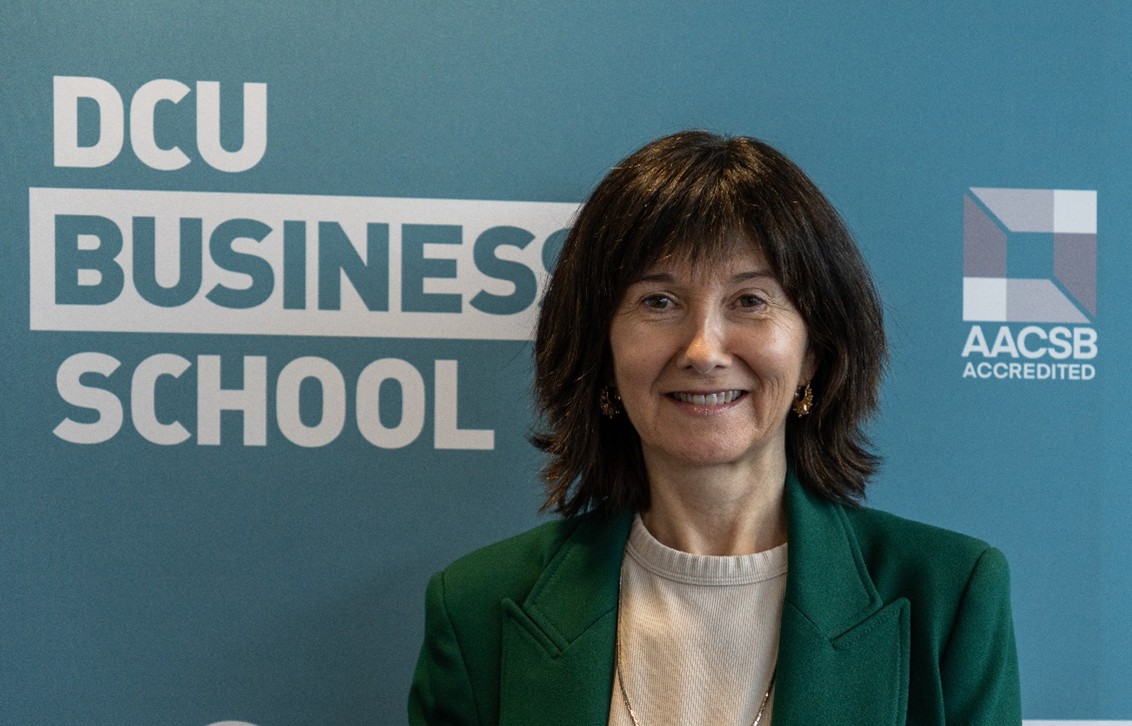
Anna Keller – Research Ireland Scholarship Ph.D. Researcher & Part-time lecturer
Anna Keller is a Research Ireland PhD Scholar at Dublin City University, where she is investigating how virtual reality workspaces can foster relationship building in virtual teams. Her research, titled “Working in the Metaverse: Building social capital to enhance relationships in virtual teams”, is based at DCU Business School and the DCU Institute for Business and Society.
Alongside her academic work, Anna lectures part-time on the Master’s in Strategic Learning & Development and brings extensive industry experience as a former Director of Global Technology in the food and beverages sector.